Everything you need to know about browsing, ordering, QC, shipping, and customs with Litbuy Spreadsheet and your China buying agent.
19 Questions 6 Categories Updated 2026 US · EU · UK · CA · AU
No questions match your search. Try a different keyword.
Getting Started
What Litbuy Spreadsheet is and how the whole system works
Litbuy Spreadsheet is a free product discovery tool — not a seller, not a shopping agent, and not a store. It collects popular and trending items from major Chinese e-commerce platforms (Taobao, 1688, Weidian, Poizon, etc.) and provides clean, organized product links so you can quickly browse, compare, and send items to your preferred buying agent for ordering.
Think of it as a curated catalogue: Litbuy finds products, you browse, and your agent (Superbuy, Pandabuy, Kakobuy, etc.) handles the actual purchase, warehousing, and international shipping.
Litbuy Spreadsheet itself never charges you anything — it's completely free. Costs only arise when you use a buying agent to order and ship items.
Yes — Litbuy Spreadsheet is 100% free. Browsing products, checking prices, copying links, and accessing guides all cost nothing.
Costs only appear once you use a third-party buying agent to place orders. Agents typically charge:
A service fee (usually 5–10% of item price)
Actual item price in CNY
International shipping fee (varies by weight, destination, and line)
Optional: extra QC, special packaging, insurance
Always check your chosen agent's fee structure before ordering. Fees vary between Superbuy, Pandabuy, Kakobuy, Acbuy, and others.
Litbuy Spreadsheet aggregates items from all major Chinese shopping platforms. You'll commonly see links from:
Taobao 1688 Weidian Poizon (得物) Xianyu Tmall
Each platform has its own pricing structure. 1688 is typically the factory/wholesale price (cheapest). Weidian and Taobao are retail-level. Poizon verifies authenticity for sneakers and streetwear.
Not all agents support every platform. Confirm your agent can order from the specific source before placing your order.
How to Order
Step-by-step guide from browsing to placing your first order
Browse Products
Open Item Page
Copy Link
Choose Agent
Place Order
Browse products on Litbuy Spreadsheet — use categories, search, or Flash Deals.
Click any item to open the detailed product page — check price, specs, photos, and available size/color options.
Copy the product link (Taobao, Weidian, 1688, etc.) shown on the page.
Choose your buying agent — Superbuy, Pandabuy, Kakobuy, Acbuy, Loongbuy, or others. See our full tutorial guide for agent setup.
Paste the link into your agent's order page, select your specs, and submit.
New to buying agents? Read the How to Use Litbuy guide first — it covers account setup, currency top-up, and first-order tips.
Litbuy Spreadsheet is compatible with any China buying agent — the product links work universally. Popular agents used by the community:
Different agents have different service fees, shipping line options, and coverage. Check our monthly shipping price comparison to find the cheapest agent for your destination country.
Once you submit and pay for your order, the process follows these stages:
Agent purchases from the seller — typically within 1–2 business days.
Domestic shipping to warehouse — seller ships to the agent's China warehouse (usually 2–5 days).
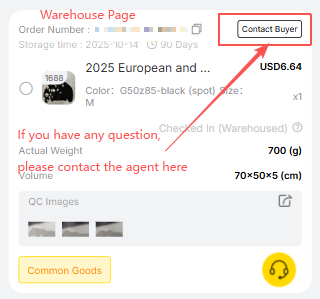
Warehouse receives & inspects — agents photograph the item and make it available in your storage.
You review QC photos — approve or reject the item before it ships internationally.
Combine items & submit parcel — group multiple items into one parcel to save on shipping.
International shipping — parcel leaves China and travels to your country.
Warehouse & QC Photos
What quality control means, what to expect, and what to do if something's wrong
Standard QC (included free with most agents) typically covers:
Style, color, and size verification — confirms what arrived matches what you ordered
Quantity check — all items in the order are present
Visible defects scan — obvious stains, damage, scratches, broken parts
3–6 warehouse photos from different angles
What standard QC does NOT cover: internal defects, smell/texture, precise size measurements, or functionality testing of electronics.
Important: Sealed, blind-box, and electronic items may have limited inspection. The warehouse can only check the outer packaging for these.
Yes. Most agents offer paid QC upgrades, which can include:
Video QC — a short walkthrough video of the item
Detail photos — close-ups of tags, stitching, soles, hardware
Measurements — actual size measurements (length, width, inseam, etc.)
Functionality test — for electronics, opening clasps, zippers, buttons
Extra QC typically costs 2–5 CNY per item depending on the agent. It's highly recommended for expensive items (sneakers, bags, jackets) or anything where fit/quality matters.
Look for the "Extra QC" or "Custom QC" button in your agent's warehouse page. Some agents offer one free extra photo if you ask in the order notes.
If the QC photos show a problem (wrong item, wrong color, visible damage), you have options:
Reject the item in warehouse — agent contacts the seller to arrange a return or replacement
Request a return/exchange — must be within the seller's return window (usually 7 days from delivery to warehouse)
Accept and ship anyway — if the issue is minor and you still want the item
Act quickly. Return windows are short. Once you approve and submit for shipping, rejections are no longer possible.
Some agents offer paid item insurance covering loss or damage during international shipping — not to be confused with QC-stage issues.
Standard free storage: 90 days from the date items arrive at the agent's warehouse.
After 90 days, storage fees begin to accrue (typically 0.1–0.3 CNY per item per day)
After an extended period of non-payment, agents may treat long-term unshipped items as abandoned per their policy
Check your specific agent's storage policy — some offer longer free periods for premium members
If you're collecting multiple items before shipping, track arrival dates carefully to avoid storage fees accumulating on early arrivals.
Shipping & Tracking
How to submit parcels, choose lines, and read tracking updates
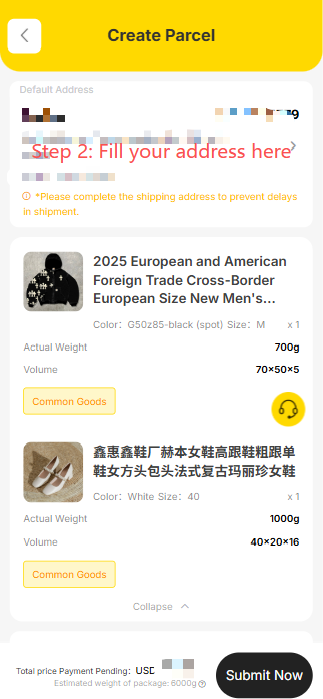
Go to Warehouse in your agent account
Select all items you want in this shipment
Click "Combine into Parcel" (or equivalent button)
Choose your shipping address
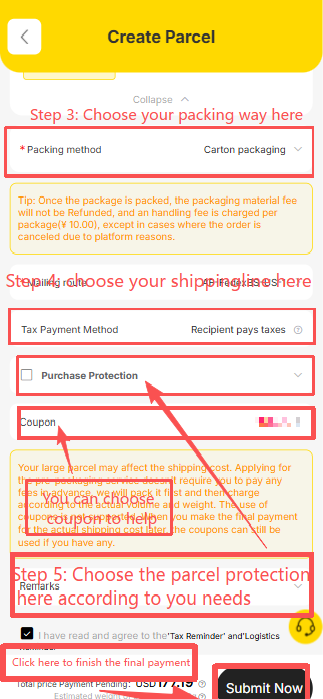
Select a shipping line (standard, tracked, DHL, etc.) — compare by price and transit time
Pay the estimated shipping fee based on declared weight
After packing, the warehouse measures the actual weight. If lower than estimated, the difference is refunded. If higher, a top-up payment is required before the parcel ships.
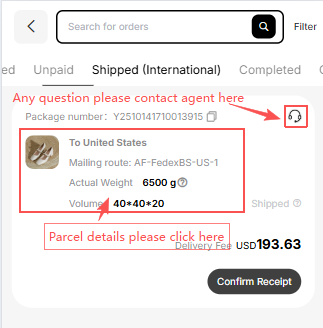
A tracking pause almost never means the parcel is lost. Common reasons for no update include:
Waiting for the next flight — parcels are batched; there may be days between flights on some routes
Customs inspection — your country's customs is holding the parcel for review (normal, usually resolves in 3–10 days)
Local carrier handoff — once it enters your country, tracking may pause while being transferred to a local carrier (USPS, Royal Mail, DHL, etc.)
Tracking system lag — especially common with postal routes; scans can appear 2–5 days late
Force majeure — weather events, holidays, or route disruptions
Only contact your agent if: no update for more than 30 days, or the last scan shows an unusual error status. Don't panic at 5–10 day gaps on standard/postal routes.
"Undelivered" means the courier attempted delivery but could not complete it. Common causes:
No one was home at time of delivery attempt
Incorrect or incomplete address on the parcel
Delivery requires signature but no one was available
Parcel is oversized for the mailbox
What to do: Once the parcel has reached your country, contact the local post office or last-mile courier directly using the tracking number. They may be holding it for collection or can schedule a re-delivery. Do not ask your China agent to intervene at this stage — they cannot affect local delivery.
Check your tracking for the carrier name — in the US this is often USPS, in the UK it's Royal Mail, in Germany DHL or Hermes. Search "{carrier name} + package pickup" for instructions.
Before signing for any parcel from China, always check:
Outer box condition — look for crushing, tears, or obvious damage
Seal integrity — tape should be unbroken; tampered seals may indicate customs inspection or theft
Weight/feel — if it feels significantly lighter than expected, something may be missing
If the box is visibly damaged or the seal is broken: Do NOT sign. Refuse the parcel and report to the courier immediately. Keep all original packaging. Take photos before opening anything. Contact your agent with photos to file a claim.
Signing for a parcel before inspecting may void your ability to claim compensation for missing or damaged contents.
Costs & Fees
How shipping is priced, what extra charges to expect, and how weight is calculated
Estimated Weight
Charged when you submit the parcel. Based on the declared weight of your items. This is a deposit — you pay this first.
Actual Weight
Measured after packing at the warehouse. If lower, you get a refund. If higher, you pay the difference before it ships.
Carriers charge whichever is higher: actual weight or volumetric weight. A large light item (e.g. a stuffed cushion, foam footwear) may cost significantly more to ship than its actual weight suggests.
Request "remove original box" or "repackage" at submission to reduce volumetric weight for bulky but light items like shoes or outerwear.
Litbuy Spreadsheet is free. But when using a buying agent, you may encounter these charges — which are standard and disclosed in each agent's fee structure:
Service fee: 5–10% of item price (buying agent commission)
Extra QC fee: 2–5 CNY per item for video/detail photos
Special packaging: bubble wrap, extra box, vacuum bag — small fee
Storage fee: applies after 90 days free storage (0.1–0.3 CNY/item/day)
Insurance: optional, typically 1–3% of declared value
Payment processing fee: some agents add a small fee for PayPal or card payments
Always read your agent's fee page before your first order. Compare agents on our monthly agent pricing page for the best overall deal.
Restrictions & Customs
What items are restricted, how customs duties work, and regional duty-free thresholds
Shipping restrictions come from a combination of carrier regulations, destination country import rules, and item category rules. Common restricted categories:
Liquids & gels — perfumes, skincare, beverages (often blocked on postal/air routes to US, EU, AU)
Powders — protein powder, makeup, loose tea — require documentation or are fully blocked on certain lines
Lithium batteries — especially standalone batteries; items with built-in batteries (phones, earbuds) have specific quantity and watt-hour limits
Food items — many countries restrict food imports from China (especially to US, AU, NZ)
Oversized or overweight items — items exceeding the line's max dimensions or weight limit
Dangerous goods — flammables, pressurized cans, magnetic items
One restricted item can block the whole parcel. Always check each item category before submitting. If unsure, ask your agent's customer support.
Not always. You may need to split items into separate parcels if:
One or more items are in a restricted category (batteries, liquids, powders)
The combined weight or dimensions exceed the shipping line's maximum
Items have incompatible packaging requirements (e.g. fragile items that need extra protection vs standard items)
Most agent platforms will automatically show which shipping lines are available based on the items in your cart — lines incompatible with your items will be greyed out or hidden.
If a line disappears from your options after adding an item, that item is likely causing a restriction. Remove it and submit separately on a compatible line.
Customs duties depend on your country's import rules and the declared value of your parcel. Most countries have a duty-free threshold — parcels valued below this are usually cleared without tax:
Country
Duty-Free Threshold
Notes
🇺🇸 United States
USD $800
De minimis rule. Most personal parcels clear below this.
🇪🇺 European Union
EUR €150
VAT applies above €150. Duty above €150 depending on category.
🇬🇧 United Kingdom
GBP £135
VAT applies above £135 from Jan 2021 post-Brexit rules.
🇨🇦 Canada
CAD $20 (mail) / CAD $40 (courier)
Low threshold — many parcels attract GST/HST.
🇦🇺 Australia
AUD $1,000
No GST/duty below $1,000 for most goods.
🇧🇷 Brazil
USD $50 (personal import)
Very low threshold. Many parcels attract 60% flat duty.
🇨🇭 Switzerland
CHF 65
Non-EU — separate customs process. 7.7% Swiss VAT.
Always declare the actual value. Under-declaring to avoid customs is illegal and can result in parcel seizure, fines, or permanent carrier bans. Some shipping lines require the recipient to pay customs duty directly to their local post office or courier upon delivery.
Still have questions?
Browse our full guide, or head to your agent's live chat for order-specific help.